
The Uncanny Valley Leads Us Home
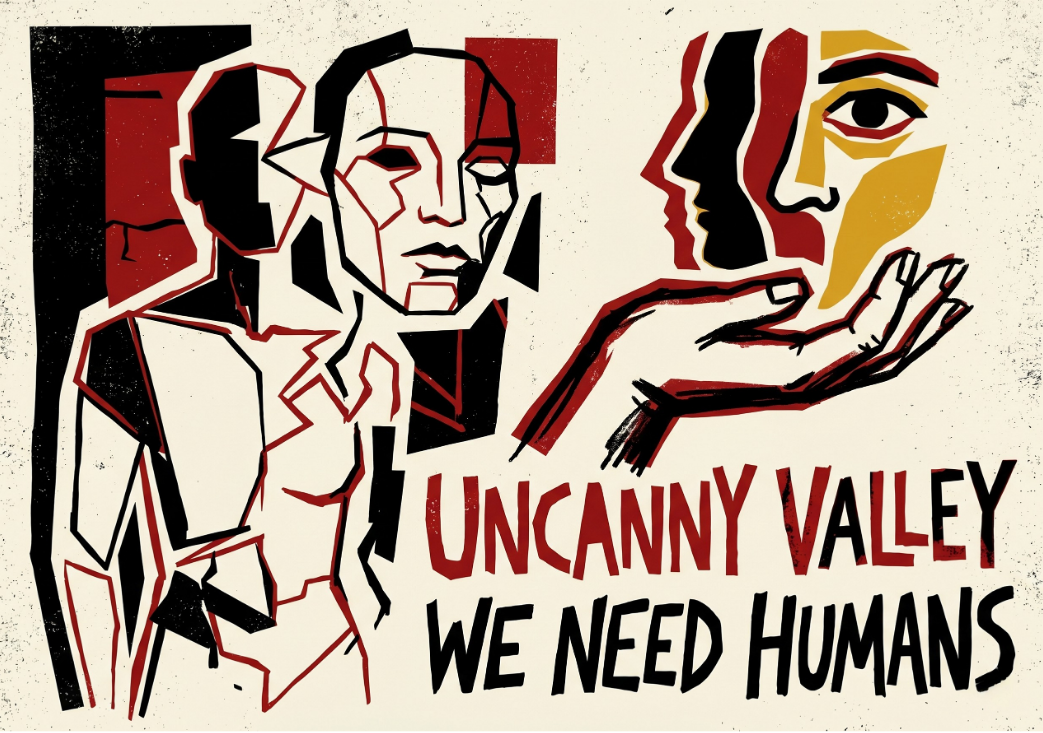
Despite AI's power and the ease of building, I think that the "Uncanny Valley" effect proves that human-centered design must remain the priority over tool-driven excitement.
AI and the Long View of UX
Let's face it, we're all learning and using AI because we have to. A big part of our job is to stay on the forefront of both the latest industry trends, and the latest design tools. AI is both (and even more). I have been a UX designer since the pre dot-com days when UX design was "human factors engineering." I designed through the dot-com boom/bust, the resulting recovery and leveling out of the web, social media madness, mobile-first design, design systems, and now AI. Having seen all that, I recognize that AI will eventually be the game-changer that it is being hyped to be. But... It will take time. And, it will never be human.
Within those landscape-shifting trends, the preferred design tools-of-the-trade seemed to change almost yearly, especially in the last 10 years. It is interesting writing from the perspective of having been a UX designer from the field's early days, before there were proper UX design apps at all. In the beginning (for me), there was Photoshop 3.0, CorelDraw 5.0, PowerPoint, Word, Excel. That was it. Good research (I have been lucky enough to work with some of the best) + design skills, and you just made it work. And it did work. There was a lot of manual, makeshift design and methodology, but the knowledge and understanding of the user was deep. As long as the user needs were put first, the results were always positive.
A Geek's Lifelong Passion for Tech
Full disclosure: I am a geek. My two favorite things are computers and guitars. Over the years I have learned that my love for both has common threads. I love to learn, tinker, tear apart, rebuild, discover how things work, why things break, customize, learn about myself while I am learning about the computer/guitar, how to leverage the instrument as a career, etc. My passion for both computers and guitars has never wavered throughout my life. I feel lucky that I discovered both when I was young, and both have remained so cool.
Because I am a geek, I inevitably stay on the forefront of tech trends, learning new tools, keeping my coding chops decent, and spending more time than I should trying to master the craft of design. So as the tools shifted from Axure RP to Balsamiq to Sketch/Zeplin to Adobe XD to UXPin to Figma (plus deep integration with design systems), I have enjoyed the often mundane learning curve involved. I also found that, regardless of the design software, as long as the user needs were put first, the results were always positive. Then came AI. It's so simple! It all just works! Look at how much I can do! Maybe I don't have a job anymore!
The Danger of Technology Blindness
At this point, we all know how shocking, cool, fun, and scary AI is. In my 6-month AI up-skilling, I had more fun with computers than I have since when I first started (and that's saying a lot). The potential seemed endless. AI is way more than a tool, it will eventually change how we do everything (read: eventually). I was cranking out working apps, prototypes, etc. in minutes. Crazy! But as the newness wore off, I recognized something that I have seen in myself and other tech/dev-saavy designers throughout my career: a tendency toward technology / tool blindness.
When a designer has strong technical ability, there’s a natural slide toward solving the interesting problem instead of the important one. This phenomenon is getting way louder in the AI era. When you can code, build, automate, prototype, ship, and now prompt to generate full flows, the work becomes centered on what the system is capable of. The tool itself becomes the focus, instead of the end-user. The designer starts thinking in implementation patterns, frameworks, and capabilities instead of user needs, friction, and context.
I have seen this before. I worked on a project at Quark where a co-worker got deep into using Visual Studio to create functional prototypes. It was really weird. She was an amazing designer, until she started using Visual Studio/code as a design tool. Our conversations suddenly went from “What does the user need to accomplish?” to “Look at what I can make the interface do.” The work became feature-led instead of outcome-led. She started validating design decisions against technical excitement instead of user value.
Developers do this because they see possibility. Designers who can code tend to get pulled by this same gravity because building is rewarding. The feedback loop is faster than research, testing, and iteration. It feels productive. When you are cranking out cool prototypes, it is hard to remember that good UX is often about restraint. Knowing what not to build. Knowing when functionality harms clarity. Knowing when simplicity wins.
The Loss of the "Effort" Filter
AI makes building feel effortless. But just because you can build it, doesn't mean that you should. Effort used to be a natural filter. If it was hard to build, you would think a lot harder about doing it, and if it was worth it, you would give a lot of consideration and planning into making it happen. Now that the cost of generating features, flows, screens, and interactions is near zero, it is way too easy to fill products with noise. Now that AI has been in the wild for a few years, we are seeing this everywhere.
The Uncanny Valley of AI
Which brings me to my last point: The Uncanny Valley. Even though AI has brought a ridiculous level of fidelity to text, images, code, prototypes, design, video, and music, we can FEEL it and something feels off. We know that something about it isn't human. It's TOO perfect, and that bothers us. I am a longtime reader of Hacker News. It is such a cool community of extraordinary and smart people. And SO much tech! It has been a great source of information on AI, trends, the latest models, etc. But the latest trend that I've enjoyed the most in the past few months is how bothered everyone is by AI generated content.
If there is even a hint of an article being written by AI (this one is not!), it is immediately called out in the comments. People are noticing machine generated content, and they don't like it. I know because I feel the same. I am seeing it everywhere and it is making me uneasy. I now have a deep knowledge of AI, how to use it, etc. and I have been wowed SO many times by what it can do. But with that knowledge, I can now see it everywhere and I can't unsee it.
The Path Forward: A Return to Human-Centered Design
Despite being a realist, I am also an eternal optimist. I think that the Uncanny Valley is the way forward. It is the human factor. Our innate ability to recognize what is real from what isn't is going to be the path toward a better future. Technology has been the advantage that has allowed humans to survive. Technology advancements are always uncomfortable. But our ability to cooperate (as people, machines, and people + machines) is how we move forward as a species. It might even be the key to a better future. I think so.
Conclusion
If nothing else, the Uncanny Valley is a reminder to UX designers to spend even more time thinking about the human on the other side of the device. Now more than ever, we need products that help people instead of continuing to throw gas on the fire of harmful algorithms that only make our existence worse. We have the ability to make the world a better place, not just generate more monthly subscriptions. Let's get back to what we do best: human-centered design. See you there.
Enterprise SaaS
platforms shipped
design rework reduction
Parallels design system
task-flow reduction
Lumen self-serve
0→production
Parallels DaaS
Get in touch
I'm always open to new projects, new ideas, and good conversationsabout design that makes an impact.